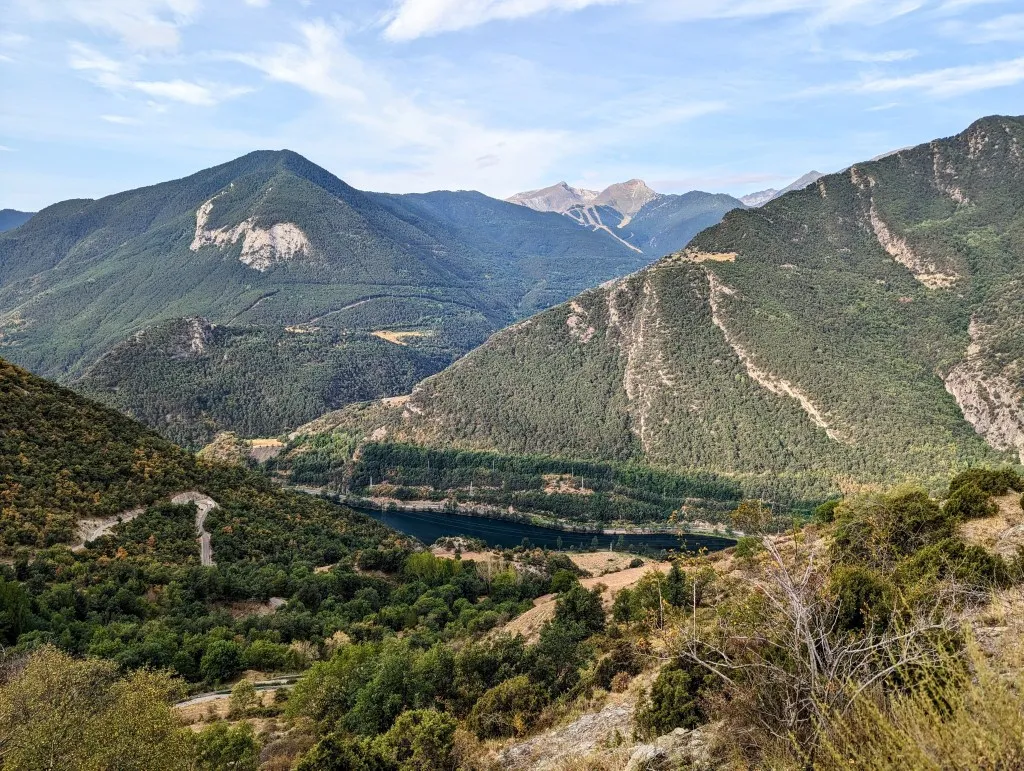
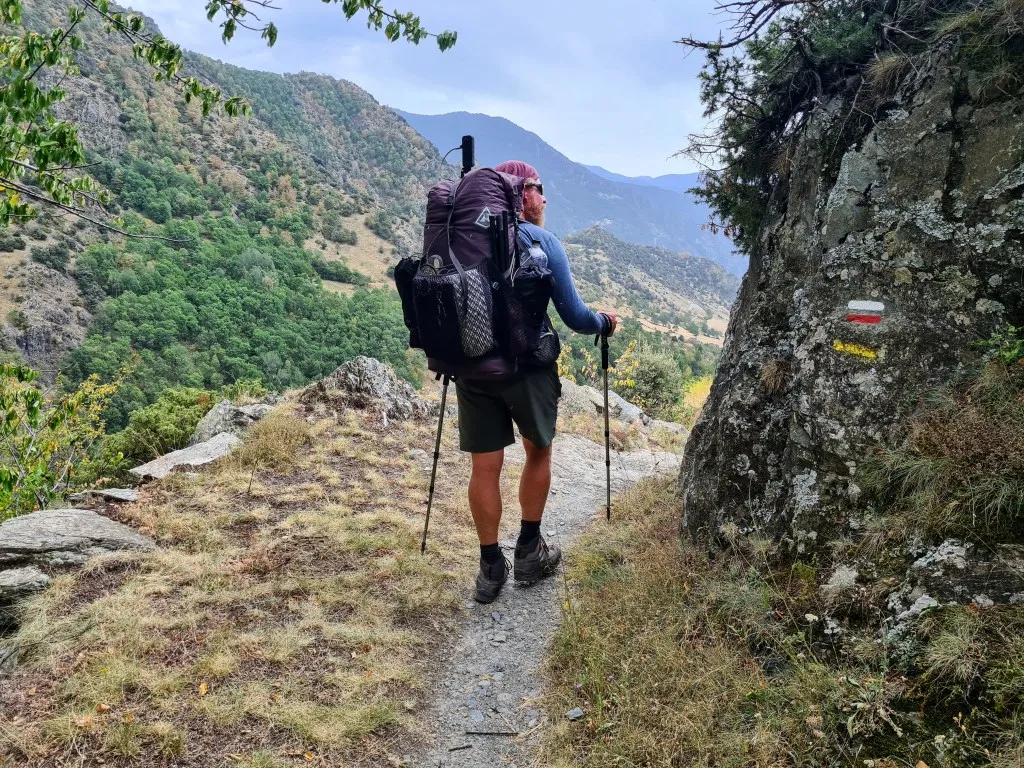
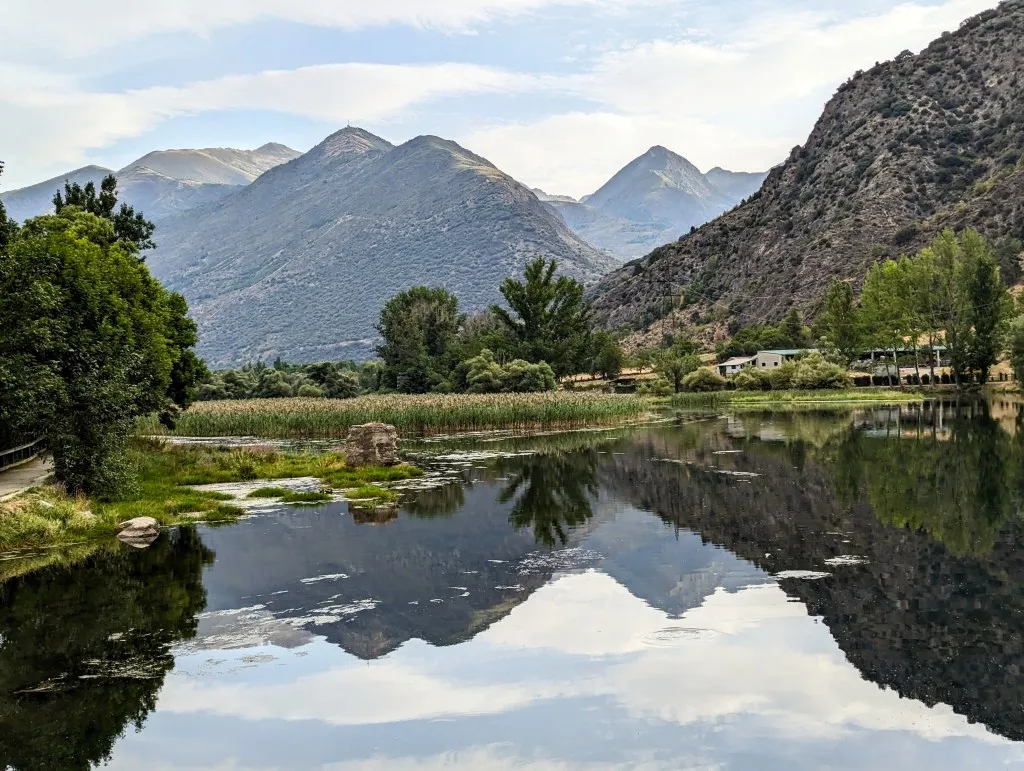
Today's stage is once again a modest one. It's just over 12.5 kilometers to the next village: Estahón. Not long, but the 2,300 meters of elevation gain make it a serious trek. It's already warm early this morning. Luckily, it's a bit cloudy, so the sun isn't too bright as we leave the campsite, pass by the few houses of the village, and cross the bridge over the reservoir of the Noguera Pallaresa River. The river originates higher up in Val d’Aran and flows via the Segre and the Ebro to the Mediterranean Sea. Barely 100 meters from its source, the Garonne also springs forth, flowing to Bordeaux where it meets the Atlantic Ocean. From the bridge, we see the high mountains to the north, while to the south, the terrain quickly becomes lower. The weather is calm, allowing the mountains to reflect beautifully in the water's surface. We follow the asphalt road along the lake for a short while before turning left. From here, the climb from just under 1,000 meters to 2,220 meters begins. Just off the river valley, the landscape immediately turns autumnal and dry. The grass is yellow, and the birch trees are already losing their discolored leaves. Many low coniferous shrubs dot the slope, remaining green. We cross a few roads that also ascend towards the village of Dorve, a village that until 2005 was only accessible on foot.
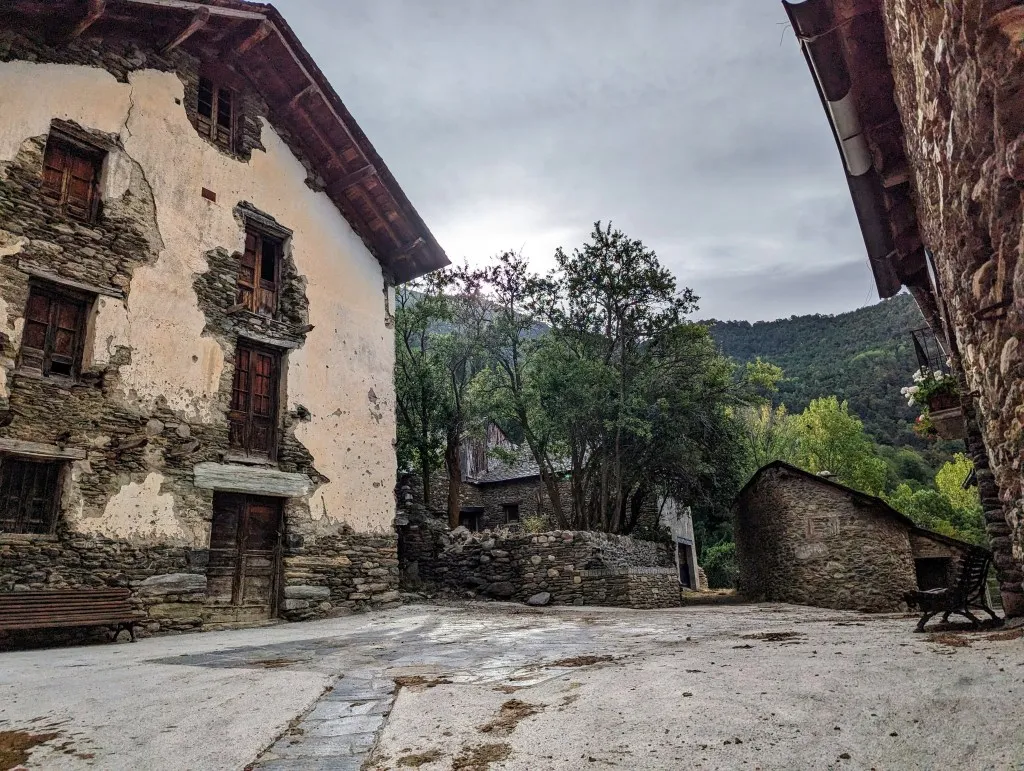
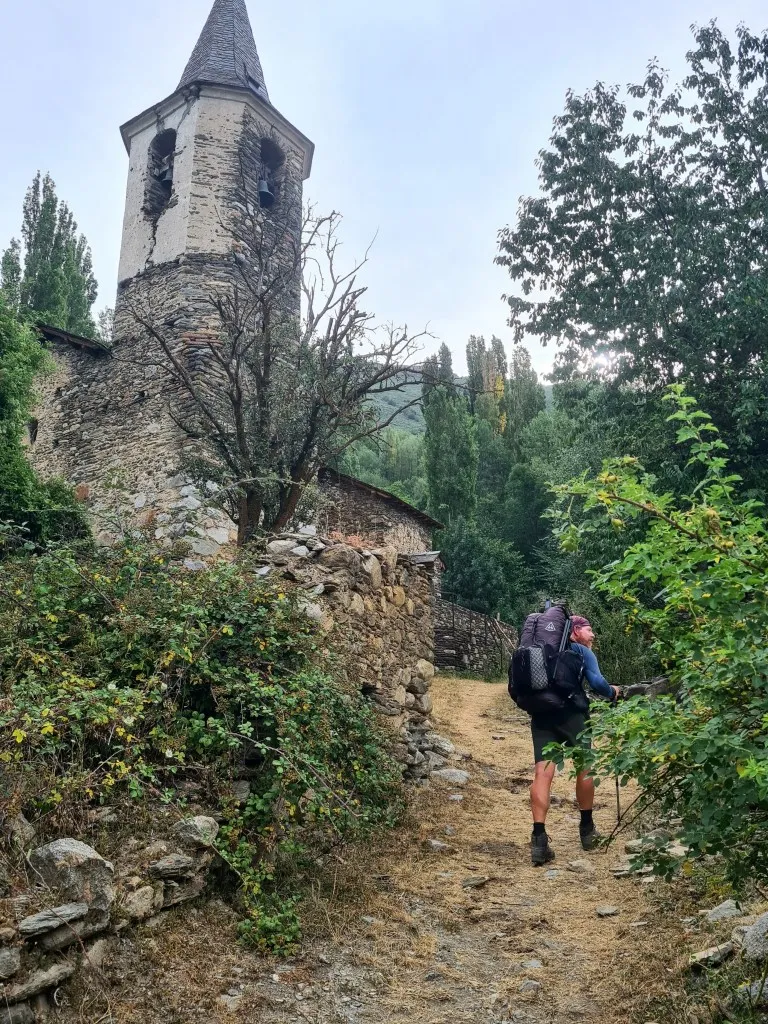
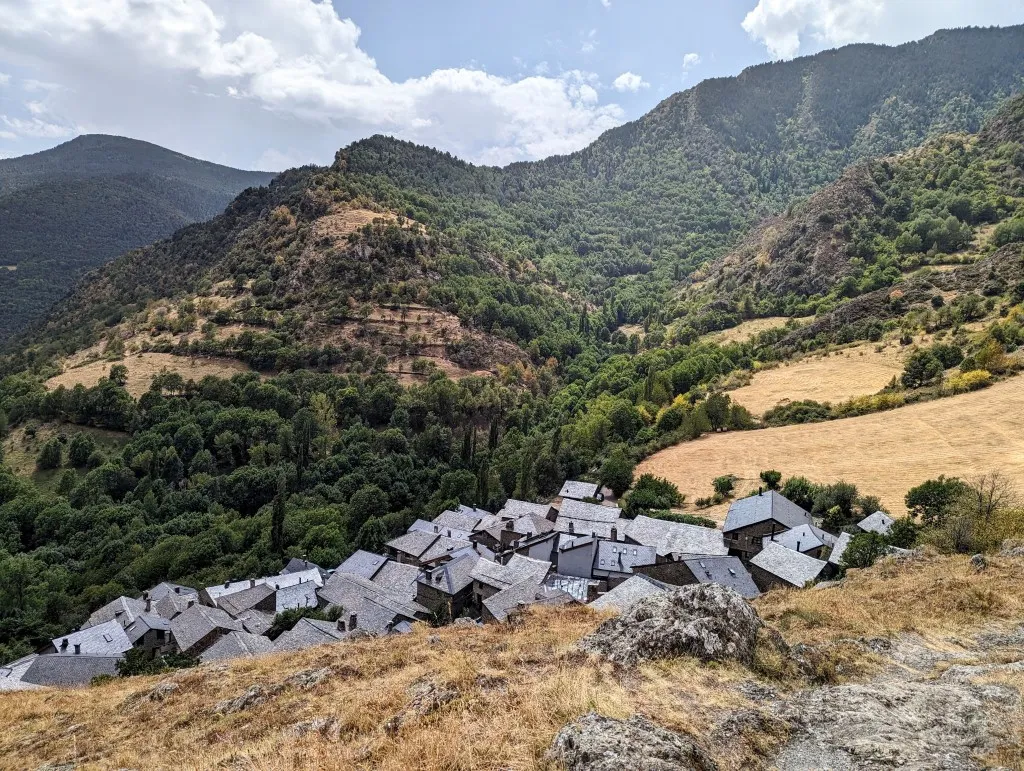
It doesn't take long for us to reach it; the collection of houses appears deserted. The road into the village is beautifully laid out. We walk through and arrive at a square that wouldn't look out of place in one of the villages in the hills of southern Spain. It looks nostalgically old, as if a village festival could take place here at any moment, but except for one house adorned with pink, red, and white geraniums, the village is deserted. Only one person has dared to renovate a house and come to live here without electricity or amenities; otherwise, all the houses are ruins with padlocks on gates that are falling apart. Except for the church, of course, which has been nicely restored. A strong stream of cold water flows from the spring in the square. It's refreshing to cool our hands and refill a bottle with fresh water after this initial ascent; we're already 450 meters higher than when we started. As we continue walking, it's evident that the landscape around the village was once cultivated. Rows of trees and stacked stones delineate the meadows and mark the path. It's an old path that is slowly falling into disrepair. As we climb higher, we quickly rise above the ruins and once again traverse the dry, rocky landscape with shrubs and occasional trees.
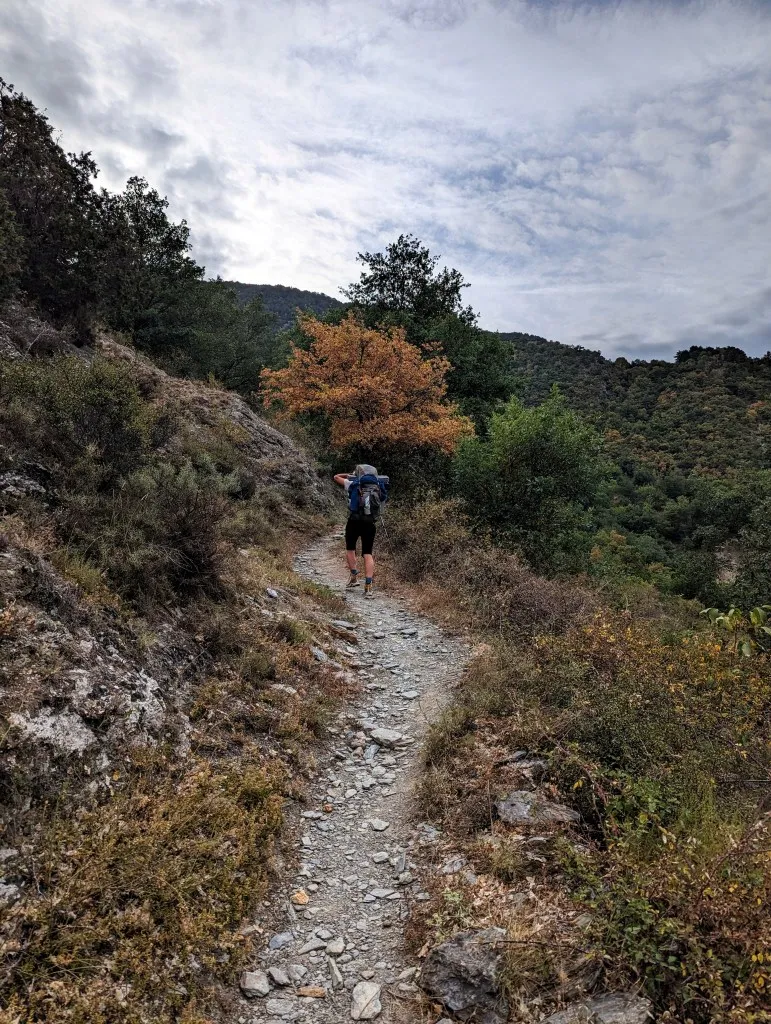
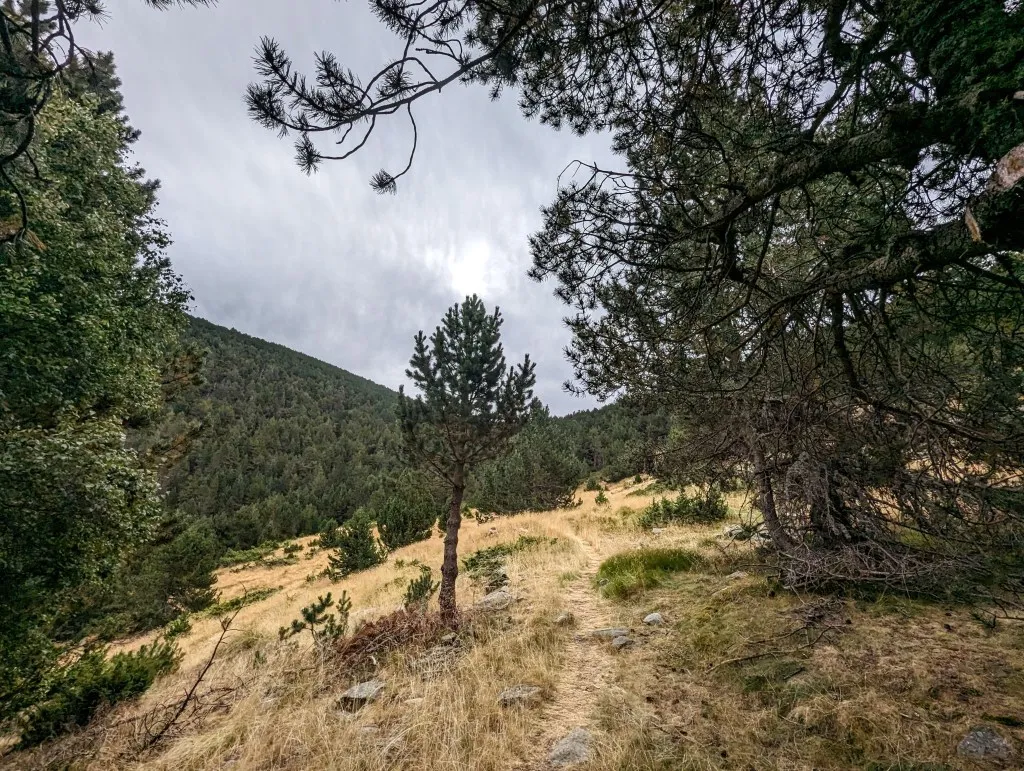
On the slope many cows are wandering, and a young bull enthusiastically runs towards us. Beautiful, tranquil animals, but we prefer to give them space and go around them. Although it's difficult to find a route around the cows outside the path due to the prickly plants. No matter how open the landscape seems, we keep running into walls of conifers, roses, and blackberry bushes. But after a bit of searching, we manage to find our way back to the path higher up. A quick break and then onwards, further up. Normally, the landscape opens up as we ascend, but here at 1,750 meters altitude, we suddenly enter a pine forest. The path continues to climb, and around 2,000 meters, the forest becomes more open. It remains wooded except for a few grassy patches until we reach the top at 2,220 meters. There, the forest breaks open a bit, and we can see clearly how high we've climbed.
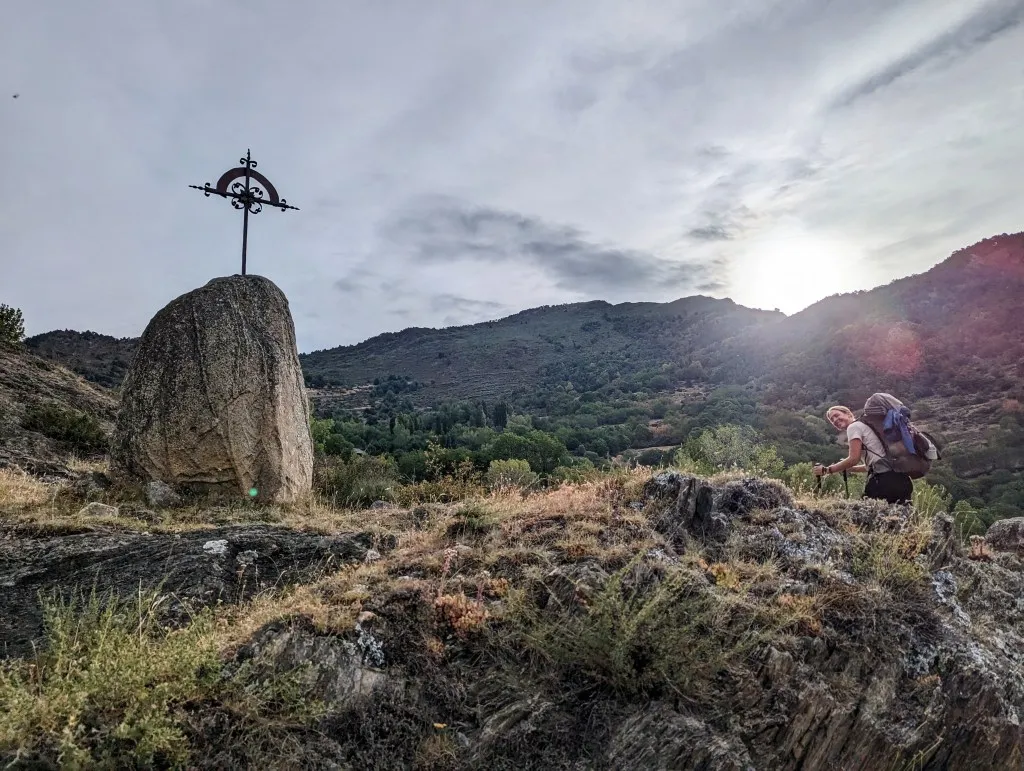
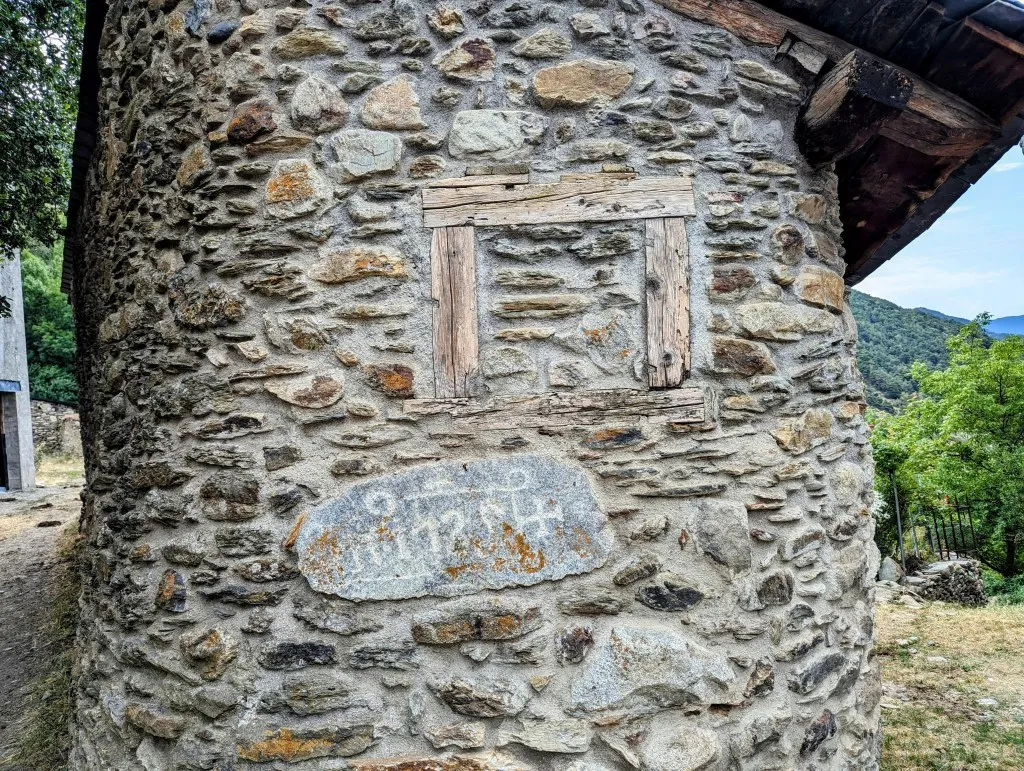
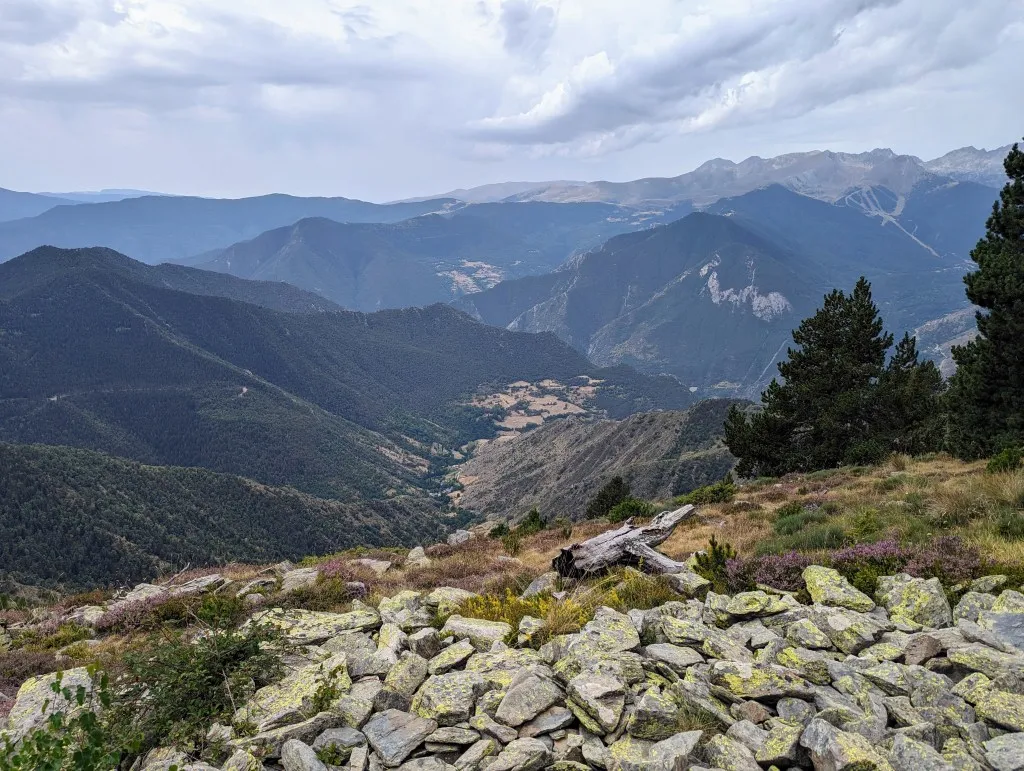
We have a magnificent panoramic view over the valleys below us. We've ascended 1,300 meters in just over 2.5 hours. Definitely time for a break! At the highest point, a group of German ladies is folding up their tents and getting ready to continue their journey. Camping is allowed here in the park above 2,000 meters, but technically only until 8 in the morning. So they've either slept in, or they've taken the opportunity to dry out their tents, like we're planning to do. Ours is still damp from the morning dew, so we'll set it up to dry properly, especially since we're staying in a refuge tonight. We chat with the ladies for a bit before they continue, leaving the mountain to ourselves once again. It's a stunning spot with magnificent views of the Pyrenees, although it's starting to cloud over. As we set up the tent to dry, it starts to rain. We briefly consider packing up and taking shelter in the tent, but before we know it, the rain has stopped. And luckily we stayed put because while enjoying a cup of coffee and a fried egg sandwich, a large group of griffon vultures glides by. They linger nearby for a while, swooping low overhead. What a spectacle during lunch! We're already well over halfway through the hike, with only 4.5 kilometers left to Estahón, where the refuge is located. The initial part of the descent is steep, but the path is manageable. The slope is wooded again, but more open than on the other side. Lower down, the forest transitions into yellow grassland with broom bushes. The lower slopes here, even more than on the other side, appear to have been cultivated for agriculture and forestry in the past, but are now slowly returning to wildness. We descend quickly, and it doesn't take long before we see the village ahead. The last stretch is along an old path made of slate that seems to cling ingeniously to the hillsides. In the final meters, we're treated to a heavy downpour, which makes the stones quite slippery, so we better not rush. And we don't have to, as by the time we pass the first houses of the village, the rain has stopped again. It's a beautiful authentic village. Every house is constructed with beautiful stacked natural stone and has a dark gray slate roof. And apart from a few exceptions, the whole village seems to be inhabited. At the refuge, we're greeted by two large dogs and the owner. She quickly shows us to the double room. The room, measuring 1.5 meters by 2.5 meters, contains a chair, a small cupboard, and a bunk bed. Our room door doesn't lock, and judging by the bedding, we're glad we brought sleeping bags and our own pillows. But at least there's daylight, and we're not sleeping in a dormitory. Next to us is the shared bathroom. Meals turn out to be included, so we have plenty of time to explore the village before dinner. It's not even half past three yet, and dinner isn't served until half past seven. We're curious to see what's to explore…